Toronto author, actor and comedian Robert Hawke is marshalling humour in the battle against cancer, after it helped him through his own bout with the disease.
Toronto comedian Robert Hawke helps cancer patients out of the “4 a.m. darkness” with his “Spoonful of Laughter” workshop.
His comedy career was riding a high-speed laugh track a decade ago, having brought him frequent appearances on CBC television and radio shows and a full-time gig with the Second City comedy troupe. “I was freelancing, things were good,” he recalls. “And I was leading what I considered to be a pretty healthy life.” But then cancer sent him off the rails.
Hawke learned he had a thyroid tumour and that the master metabolism gland would have to be removed. The diagnosis and treatment proved psychological blows as much as physical ones. During weeks of fretful recovery, however, he hit upon this “funny idea” — to combat his cancer with comedy. The material he started developing and writing then would build a new calling and career.
“Once I started doing (comedy) work that addressed the cancer experience, I realized there was a real need for it,” says Hawke, now 50. That need found its source in the deep wells of fear, despair and isolation into which cancer patients often fall. Using his comic skills to make cancer patients laugh, he thought, could help haul them out of that “4 a.m.” darkness and allow them to more readily share their experiences and insights about their battles with others in similar straits.
CHRIS SO/ Toronto Star
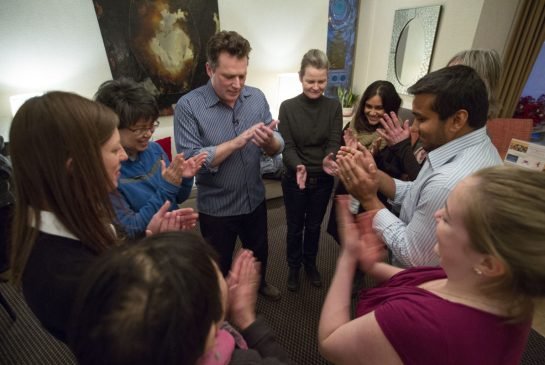
Comedian and cancer survivor Rob Hawke, in blue striped shirt, leads an improv class of cancer patients at Gilda’s Club to encourage group laughter.
Hawke has developed several programs to address different audiences. For cancer patients themselves, his “Spoonful of Laughter” routine is a 40-minute exercise that leans heavily on teaching improv techniques in groups large and small. Another, called “NormVsCancer,” is an irreverent one-man show that OpenLab helped him bring into hospitals and other medical settings. He also created a program — Adventures in Patient-Centred Care — that teaches second-year University of Toronto medical students how to interact with more humour and humanity in the clinic.
Hawke believes that shared laughter is a key to opening cancer patients up to the camaraderie, comfort and expert advice — the “wisdom in the room” — that can be found in fellow patients. And the reactions of patients involved in one of his recent improv exercises seemed to bear him out.
“I don’t think we get enough opportunities to laugh,” said participant Nadha Hassen, 26, who is battling thyroid cancer. “It’s amazing to … be in a space with other (patients). I feel like I just took this amazing stretch.”
Hawke also published a how-to book in 2011, called Kicking Cancer’s Ass: A Light-Hearted Guide to the Fight of Your Life. It offers cancer patients strategies on dealing with doctors, setting up support groups, making healthier choices and overcoming the bouts of worry and depression the disease can bring.
Many thanks to The Star, Joseph Hall, Gilda’s Club Toronto and UHNOpenlab
Have you ever felt like your concerns are utterly different from anyone else’s?
Sure you have! We all have different circumstances in our lives. For instance, I am wondering… Will the tires last on our car? Will the vacant lot down the street become a giant condo complex and ruin our view? Will Stephen King come to my poker game?
Stephen King considers coming to my poker game. I hope he brings chips.
(Ok, maybe I made up the one about the car).
We all think our concerns and problems are completely unique, but are they?
I am currently working on a program for people who are having a really hard time. Now, this group is facing incredible challenges that are very specific. However, I’ve noticed in my years working with different groups that a lot of the things we face can be really similar.
Some few years ago, I thought the challenges facing me as a cancer patient were unique not just to cancer patients but to me. Yup. I thought my story and my bit of hardship was incredibly important and oh so precious. And to a degree it was, as an experience with cancer should not be diminished at all. What I am saying is that if we hang around on the planet long enough, chances are, we’re going to experience some kind of hardship. It’s part of this thing called being human.
Think about the people you are closest to. Do they have their gooey, unresolved human bits? Do they have a challenge in their lives that they find really tough, be it addiction, an emotional issue or just getting through the day in this ridiculously complex world? I’m going to guess that’s a big “YES!“.
Its not like he needs my help, but Alec’s Podcast is terrific. Go ahead, click on it.
You see, it’s really easy to look at the shiny happy people (to quote REM- and why not? They rock.) and think that we are the only ones struggling to get out of bed in the morning, or working really hard to connect with our family, or dealing with a health issue. I was listening to one of my favourite podcasts by Alec Baldwin and he had Paul Simon on as a guest. Alec said he wanted to know what it was like to grow up being Paul Simon. Paul paused for a second and said “Hey, Everything happens to everybody.” I think that sums it up really well. Everything does happen to everybody. Especially over time.
You could say that this statement is trite and patently untrue. In a literal sense you would be correct. You could say to me “Hey Rob, This thing happened to me. It did not happen to you. Do not lessen the importance of my experience.” Point taken. After all, I once barfed in the train station in Hanoi at 5:30 am.
I barfed in this building once. I’m sorry Hanoi.
Has that happened to everybody? I sure hope not. Especially for the train station. However, I’m pretty sure we all go through some very basic human experiences that really seem to be the cost of the ticket to this ride called life. I think we all experience joy, love, loss, fear, connection, frustration, envy and of course a desire for a Led Zeppelin Reunion (ok maybe that’s just a few million of us).
Neil is awesome. That is all.
But in my work with cancer patients, their families, corporations, healthcare professionals, executives, and young people, I am starting to notice that the specifics of our challenges may be very different, but we are all out there, trying to find our way, trying to make a better life for ourselves and our families and trying to make sense of a world that may not make sense*. Wherever you are, to quote another great musician, keep on rockin’ in the free world.
*When Stephen King does come to my poker game, I’m sure he’ll call me on that run on sentence. Hey Stephen, read it out loud and it sounds fine! By the way, I just finished Finders Keepers and I loved it.
At a recent event for The Canadian Mental Health Association Waterloo Wellington Dufferin, I was thrilled to present The Wellness Solution: Help Yourself Help The World. During one of the breaks, I was lucky enough to meet Laura McShane and we got talking about compassion fatigue. She agreed to a brief interview for this blog. But what does any of this have to do with AC/DC?
Rob: So, we’ve talked about compassion fatigue and I’m wondering could you just tell me at a very basic level what it is?
Laura: Yes, compassion fatigue is the cost of caring. It impacts the caring part of us that brought us into the helping field.
R: Is it just Mental Health Professionals who suffer from compassion fatigue?
L: Gosh, No. Everyone in the caring professions can be affected. Nurses, physicians, first responders and therapists can all be impacted by compassion fatigue. It goes beyond professions too. Parents looking after a sick child or caregivers of family member can be affected as well.
R: I read in some of my research that people who are affected by compassion fatigue sometimes take on the feelings of the people they are helping.
L: Caring professionals can be impacted by listening to the traumatic experiences and details of a client’s life and it can be very distressing for them.
R: Is there stigma in talking about it?
L: Well, I don’t know if I would call it stigma, but I would say that sometimes it might be difficult to address it because of a worry people might think that they aren’t capable of doing their jobs, which isn’t true. Compassion Fatigue affects the most caring, hard working people.
R: How did you learn about this and then become a trainer?
L: Well, I took a terrific workshop called “Walking The Walk” by Francoise Mathieu, which was really amazing. (link here) she has done some great work on compassion fatigue and vicarious trauma . The management team of CMHA WWD believe it is important to acknowledge that it exists and help provide staff with some strategies to cope with the impact.
R: What is one of the ways to deal with compassion fatigue?
L: Having a transition ritual is a great way to help cope. A transition ritual helps you make a separation between your work life and your home life.
R: How does that work?
L: Well, when you’re done for the day and you’re going home, you might want to crank AC/DC on your car stereo and sing sing sing!!!
R: That’s hilarious! And that’s a transition ritual?
L: Yes, it can help us draw the line between these two worlds so we don’t take the concerns of our work home with us.
R: What are some others?
L: Well, some others might be allowing ourselves to think about work up until a certain point in our drive home, say up until a marker on our drive, like a Tim Hortons. And then after that spot, we only think about our personal life and we leave work behind.
R: Any other ones?
L: Sure! A really great way of transitioning from work to home is to get out of our work clothes immediately after we get home and then getting into a more comfortable outfit. It can really help us change our mindset.
R: Do you have any stories from your own experience about dealing with compassion fatigue?
L: Yes I do. It was earlier in my career and I came home from work one day and I had a really rough day. There had been endless appointments and I had helped people all day long. I was exhausted. When I walked in the door, my daughter was so excited to see me and she wanted to go outside and play, bike ride, catch frogs, colour, and do all kinds of things. I said “Oh honey, Mummy is really tired right now, can I just have five minutes of quiet please because I have been helping people all day.” She looked at me and said “But Mummy, you’re my Mummy.”
R: Wow!
L: And at that point I knew I had to make some changes.
R: Sometimes kids can have such clarity.
L: (laughs) Oh yes.
R: Is compassion fatigue something that we ever solve? Or is it something we have to deal with continually?
L: Well, I suppose it’s different for everyone. But, I don’t think we’re ever done. It’s part of the price of being a caring professional. One thing that a lot of people don’t realize is that this builds up over time and has a cumulative effect. So, you can be in one job and then take another position somewhere else and your level of compassion fatigue might become more and more intense. Just because we have changed jobs doesn’t mean that we have solved the issue. It’s really important for us to keep looking after ourselves and making sure that we are making our self care a priority. That way, we can continue to do the work that we love and finish our day experiencing compassion satisfaction.
R: Thank so much for talking to me about this today! I really appreciate it.
L: You’re welcome! Thanks Rob.
R: To celebrate the awesomeness of this interview, let’s all crank “You Shook Me All Night Long” By Angus and the boys.
I am thrilled to be included in an article in The Toronto Star on Healing and The Arts. There are so many people doing really important, groundbreaking work in this field. An excerpt is below. By Joseph Hall-Toronto Star
Humour out of darkness
Toronto author, actor and comedian Robert Hawke is marshalling humour in the battle against cancer, after it helped him through his own bout with the disease.
Toronto comedian Robert Hawke helps cancer patients out of the “4 a.m. darkness” with his “Spoonful of Laughter” workshop.
His comedy career was riding a high-speed laugh track a decade ago, having brought him frequent appearances on CBC television and radio shows and a full-time gig with the Second City comedy troupe. “I was freelancing, things were good,” he recalls. “And I was leading what I considered to be a pretty healthy life.” But then cancer sent him off the rails.
Hawke learned he had a thyroid tumour and that the master metabolism gland would have to be removed. The diagnosis and treatment proved psychological blows as much as physical ones. During weeks of fretful recovery, however, he hit upon this “funny idea” — to combat his cancer with comedy. The material he started developing and writing then would build a new calling and career.
“Once I started doing (comedy) work that addressed the cancer experience, I realized there was a real need for it,” says Hawke, now 50. That need found its source in the deep wells of fear, despair and isolation into which cancer patients often fall. Using his comic skills to make cancer patients laugh, he thought, could help haul them out of that “4 a.m.” darkness and allow them to more readily share their experiences and insights about their battles with others in similar straits.
CHRIS SO/ Toronto Star
Comedian and cancer survivor Rob Hawke, in blue striped shirt, leads an improv class of cancer patients at Gilda’s Club to encourage group laughter.
Hawke has developed several programs to address different audiences. For cancer patients themselves, his “Spoonful of Laughter” routine is a 40-minute exercise that leans heavily on teaching improv techniques in groups large and small. Another, called “NormVsCancer,” is an irreverent one-man show that OpenLab helped him bring into hospitals and other medical settings. He also created a program — Adventures in Patient-Centred Care — that teaches second-year University of Toronto medical students how to interact with more humour and humanity in the clinic.
Hawke believes that shared laughter is a key to opening cancer patients up to the camaraderie, comfort and expert advice — the “wisdom in the room” — that can be found in fellow patients. And the reactions of patients involved in one of his recent improv exercises seemed to bear him out.
“I don’t think we get enough opportunities to laugh,” said participant Nadha Hassen, 26, who is battling thyroid cancer. “It’s amazing to … be in a space with other (patients). I feel like I just took this amazing stretch.”
Hawke also published a how-to book in 2011, called Kicking Cancer’s Ass: A Light-Hearted Guide to the Fight of Your Life. It offers cancer patients strategies on dealing with doctors, setting up support groups, making healthier choices and overcoming the bouts of worry and depression the disease can bring.
However, sometimes our “muscles” of compassion and empathy can get tired. You might be easily distracted when you’re with the people you serve. You might not care as much or be using your skills to the best of your ability.
It can be hard for us to admit that this is happening to us. We’d rather just push through it and pretend it isn’t there.
Then kablam! You realize “I’m suffering from compassion fatigue!”
It can feel like everyone is dealing with this better than we are. I’ll tell you a secret about humanity though, we all have our issues. Even the well adjusted “superstar” of your team can have a hard time with compassion fatigue.
So, how do we help ourselves through this? One of the great ways is to collaborate with our peers.
Wait. What?
Really. Collaborating with our peers can help us like crazy.
It struck me that that there are literally thousands in the caring professions who are working really hard, giving generously of themselves and sometimes feeling really worn out in body and psyche because of the nature of this demanding work. I am guessing that no one in the world has this whole thing solved. Yep. No one. However, if we have one small piece of the puzzle worked out, shouldn’t we share what we have?
I had the honour recently of presenting my keynote “The Wellness Solution: Help Yourself Help The World” for The Canadian Mental Health Association: Waterloo Wellington Dufferin. I asked people to share how they dealt with this when they were having a tough day.
What happened my friends, was significant.
People stood up, talked and joked. They shared solutions and strategies to help each other with this tough issue and the energy of the room took off. As a speaker, it was so much fun to see more than a hundred people dive in and collaborate. In fact, folks were so pumped about helping each there that I had trouble ending the exercise and getting on with the show. It was a real testament to how generous people in the caring professions are and how, when we share what we have, everybody wins.
When the day ended, people were happier knowing that they helped their colleagues and that they had learned some valuable tools they could use the next time the elephant tried to sneak back in the room.